Senate of Canada · 2 February 2017

CIF Before the Senate.

The Center was called as a witness on what robotics, 3D printing and artificial intelligence would do to Canadian healthcare. Nine years have passed. Every claim it made that day is on the public record, so here is the scorecard, including the parts it got wrong.

Date2 February 2017
BodyStanding Senate Committee on Social Affairs, Science and Technology
StudyRobotics, 3D printing and artificial intelligence in the healthcare system
WitnessAbishur Prakash, Director, 2012 to 2022
Appearing withDr Bertalan Meskó, by video from Hungary
RecordCommittee evidence, 42nd Parliament

The full transcript is published by the Senate of Canada. The committee's report, Challenge Ahead, followed in October 2017.

What the Center said

The Senate of Canada committee page for the Standing Committee on Social Affairs, Science and Technology, Issue No. 14, Evidence, 2 February 2017.

The evidence was a survey of what other countries were already doing and Canada was not. Robots delivering medicine and changing sheets in American hospitals. A smart contact lens in South Korea monitoring diabetes through the eye. Printed blood vessels implanted in a monkey in China. A robot pharmacist in the UAE dispensing twelve medications in under a minute. Eleven robots in Saskatchewan, one of them reaching a First Nations reserve.

Underneath the examples sat one recommendation, repeated to several senators. Japan had published a New Robot Strategy. China had Made in China 2025 and a single province with $150 billion earmarked. Canada had neither a federal robotics strategy nor a provincial one. The Center told the committee that grants are not a strategy.

The scorecard

Graded in 2026 against public evidence. Sources on each row.

Held up

Canada needs an official robotics strategy.

2017 Japan had a New Robot Strategy. China had Made in China 2025. Canada, the Center told the committee, had grants.

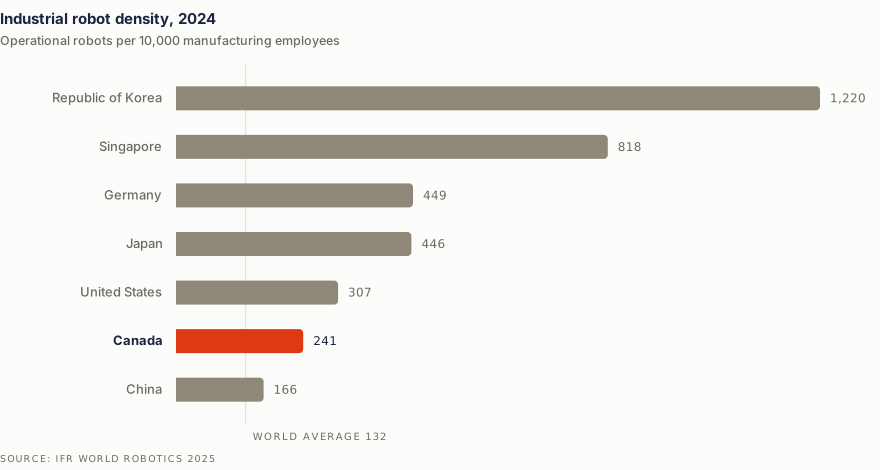
2026 Canada still has no federal robotics strategy, and no provincial one. The 2026 national AI strategy names robotics once, as a sector. Canada installs 241 robots per 10,000 manufacturing workers, against Korea's 1,220.

CIGI, 2024 ›
Held up

Hospitals will rent robots rather than buy them.

2017 A subscription model, argued against six-figure capital outlays that lock a hospital into the year it purchased.

2026 Robotics-as-a-Service is now a named category worth roughly $2 to $3 billion. Diligent Robotics' Moxi runs in about 100 US hospitals and is not sold outright to any of them.

Fortune Business Insights ›
Held up

Phones will talk to biosensors and monitor people continuously.

2017 Described as remote monitoring through a device the patient already owns.

2026 Apple Watch sleep apnea notifications cleared by the FDA in 2024, hypertension notifications in 2025, and Dexcom Stelo cleared as the first over-the-counter glucose biosensor in 2024.

FDA clearances, 2024 to 2025 ›
Partly

An algorithm will diagnose skin cancer.

2017 Cited as an early example of machine diagnosis reaching clinical standard.

2026 The most vindicated call. DermaSensor cleared in 2024, and NICE conditionally recommended Skin Analytics' DERM for the NHS in 2025 after more than 165,000 patients. But published models lost most of their accuracy on darker skin, and NICE now requires clinician review for Black and brown patients.

NICE, 2025 ›
Did not hold

IBM Watson prescribed the same treatment as doctors 99 per cent of the time.

2017 Offered to the committee as evidence that clinical AI was ready.

2026 The number was real and the inference was wrong. Agreement with doctors measures imitation, not correctness. Seventeen days after this testimony, an audit found MD Anderson had spent more than $62 million on Watson without using it on a patient. IBM sold Watson Health in 2022 for a reported $1 billion, against roughly $4.6 billion spent assembling it.

STAT, 2018 ›
Did not hold

42 per cent of Canadian jobs, 7.5 million, are at risk of automation.

2017 Taken from the Brookfield Institute's 2016 study and used to argue urgency.

2026 Canada added about 2.6 million jobs between 2017 and 2026. Retrospectives now call that generation of automation forecasts wildly inaccurate. The C.D. Howe Institute published a rebuttal six weeks after this hearing. The Center cited the alarming study when the counter-evidence was already available.

Harvard Data Science Review, 2025 ›
Did not hold

AI on phones will spot an epidemic from patterns of coughing and sneezing.

2017 Offered as a public health application of ambient sensing.

2026 This got the largest possible test. A UK study of audio from 67,842 people during COVID found models that looked 98.5 per cent accurate had simply learned to detect symptoms. Against a symptom questionnaire, the audio added nothing.

Alan Turing Institute ›
Still open

Pathology and radiology will be automated within 15 to 20 years.

2017 A window running to 2032 at the earliest.

2026 Nine years in, running the other way. Radiologist pay reached a record in 2025, roughly 4,300 US posts sit open, and fewer than 15 per cent of US health systems have even chosen a digital pathology vendor. Geoffrey Hinton's harder version of this call, made in 2016, has been withdrawn.

Canadian Association of Radiologists, 2026 ›

What still stands

Industrial robot density by country in 2024. Canada 241 robots per 10,000 manufacturing employees, world average 132, Republic of Korea 1,220.

Canada does not have too many robots. It has too few. At 241 per 10,000 manufacturing workers it sits behind Korea, Singapore, Germany, Japan and the United States, and it imports nearly all of them.

The recommendation survived the reasoning that produced it. In 2017 the Center argued Canada needed a robotics strategy partly because automation was about to take 42 per cent of Canadian jobs. It did not. Canada added roughly 2.6 million jobs instead.

The Canadian Robotics Council, formed five years after this hearing, is still asking for the same document the Center asked for in 2017.

That is the useful thing about being on the record. A position taken in public can be checked, and the parts that break tell you more than the parts that hold.

Committees, hearings and briefings

The Center gives evidence.

It has appeared before a Senate committee and been cited by the Brookings Institution and the Foreign Policy Research Institute. Committees, agencies and standards bodies working on robotics, automation or AI policy can write to hello@innovatingfuture.com.

Start a conversation ›